Econometrics vs attribution: measuring B2C marketing impact
Analytical Alley Team
Marketing Analytics Experts
Are you struggling to prove which marketing channels actually drive sales? In a world of fragmented customer journeys and strict privacy laws, relying on a single measurement source often leads to was...
Are you struggling to prove which marketing channels actually drive sales? In a world of fragmented customer journeys and strict privacy laws, relying on a single measurement source often leads to wasted budget and missed growth opportunities.
Understanding the fundamental measurement gap
The primary challenge in modern marketing is distinguishing between correlation and true causation. While many tools claim to track the customer journey, there is a significant divide between tactical tracking and strategic modeling. Attribution focuses on the individual user, attempting to map every click and touchpoint leading to a conversion. This approach is highly granular but often narrow, missing the broader context of why a sale happened.
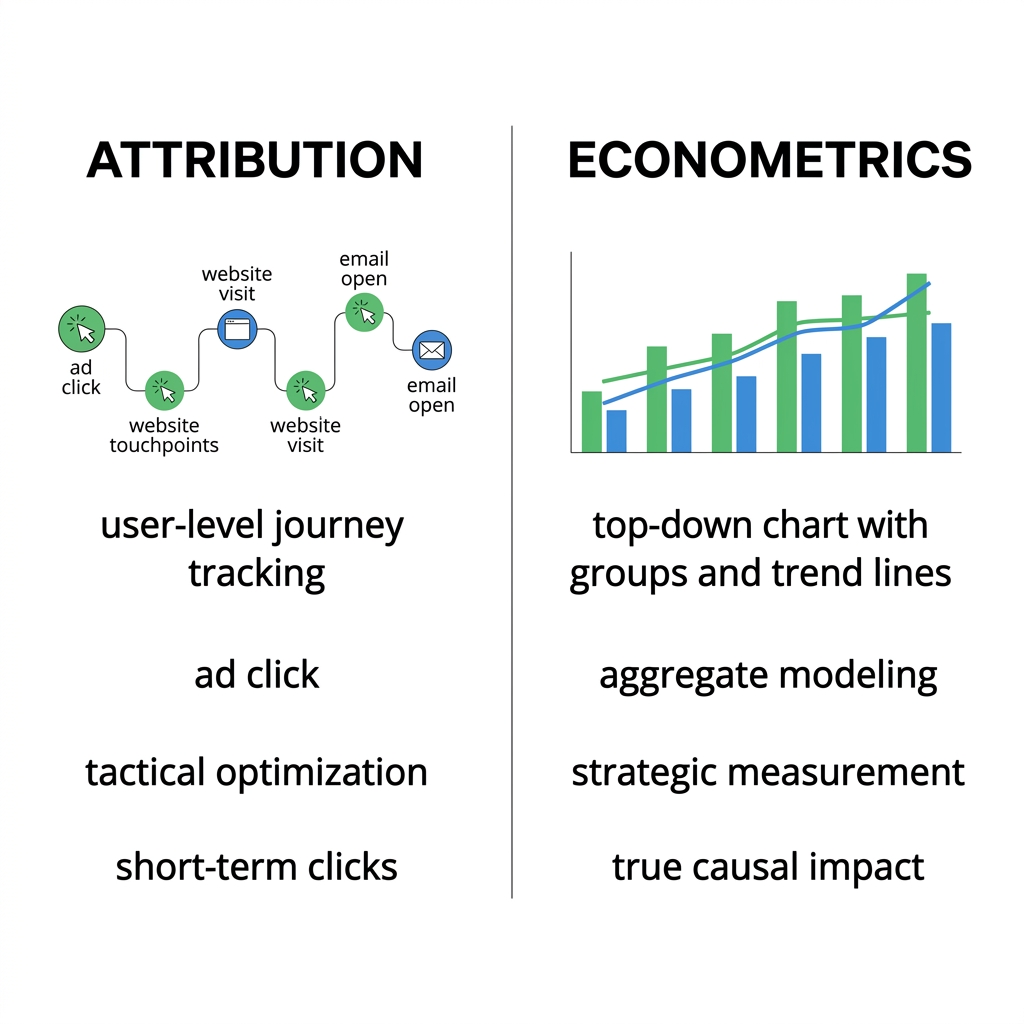
In contrast, econometrics, often referred to as marketing mix modeling, takes a top-down view. It uses aggregate historical data to understand how various factors, including media spend, pricing, and even the weather, influence your total sales. By looking at the big picture, you can identify the true marketing effectiveness of your investments without needing to track every individual user across the internet.
The role of attribution in tactical execution
Attribution is a powerful tool for day-to-day optimization. It allows media buyers to see which specific keywords, creatives, or ad placements are generating immediate responses. This granularity is essential for real-time bidding and short-term campaign adjustments. When you need to know which Facebook ad creative is outperforming another within a specific week, attribution provides the necessary feedback loop.
However, attribution has inherent limitations that can mislead C-suite executives. Most digital platforms use last-click or data-driven models that naturally overvalue bottom-funnel channels like branded search or retargeting. These models often claim credit for sales that would have occurred anyway, ignoring the baseline sales that exist regardless of marketing activity. Furthermore, platform-reported figures frequently miss 30 to 60 percent of actual marketing impact because they cannot see offline interactions or account for users who opt out of tracking.
Limitations of the user-level approach
The rise of privacy regulations such as GDPR and technical changes like iOS ATT has severely degraded the accuracy of user-level tracking. In the current landscape, relying solely on cookies and clickstreams creates massive data gaps. Attribution models struggle to bridge the gap between devices or measure the impact of traditional media like TV, radio, and out-of-home advertising. If your brand relies on a mix of online and offline channels, a digital-only attribution model will provide a skewed view of your metrics to measure advertising effectiveness.
The strategic advantage of econometrics
Econometrics solves the visibility problem by moving away from individual tracking. Because it uses aggregated data, it is inherently privacy-safe and resilient to the "cookieless" future. This method allows you to quantify the incremental ROI vs platform ROAS, ensuring you only credit marketing for sales that would not have happened otherwise.
By analyzing two to three years of historical spend and sales data, econometric models can isolate the carryover effects of brand-building campaigns. For instance, a TV ad might not drive an immediate click, but it can increase search volume and conversion rates for weeks after it airs. Econometrics captures these synergies, helping you understand how awareness channels amplify your performance marketing.
Capturing the baseline and external factors
One of the most valuable outputs of an econometric model is the identification of baseline sales. In many established B2C categories, the baseline accounts for 40 to 70 percent of total revenue. Attribution models often mistake this organic demand for marketing-driven conversions. By accurately measuring incrementality, econometrics prevents you from over-investing in channels that simply "cherry-pick" customers who were already planning to buy.
Furthermore, econometrics accounts for external variables that attribution ignores. Factors such as competitor actions, economic shifts, seasonality, and promotional periods are integrated into the model. This holistic view ensures that a sales lift during a holiday period is attributed to the correct driver rather than just the most recent ad click.
Building a unified measurement framework
You do not have to choose between one or the other. The most sophisticated B2C organizations use a hybrid approach to maximize their returns. This involves using GA4 vs econometrics in a complementary fashion: econometrics sets the high-level budget, while attribution optimizes the execution within those budgets.
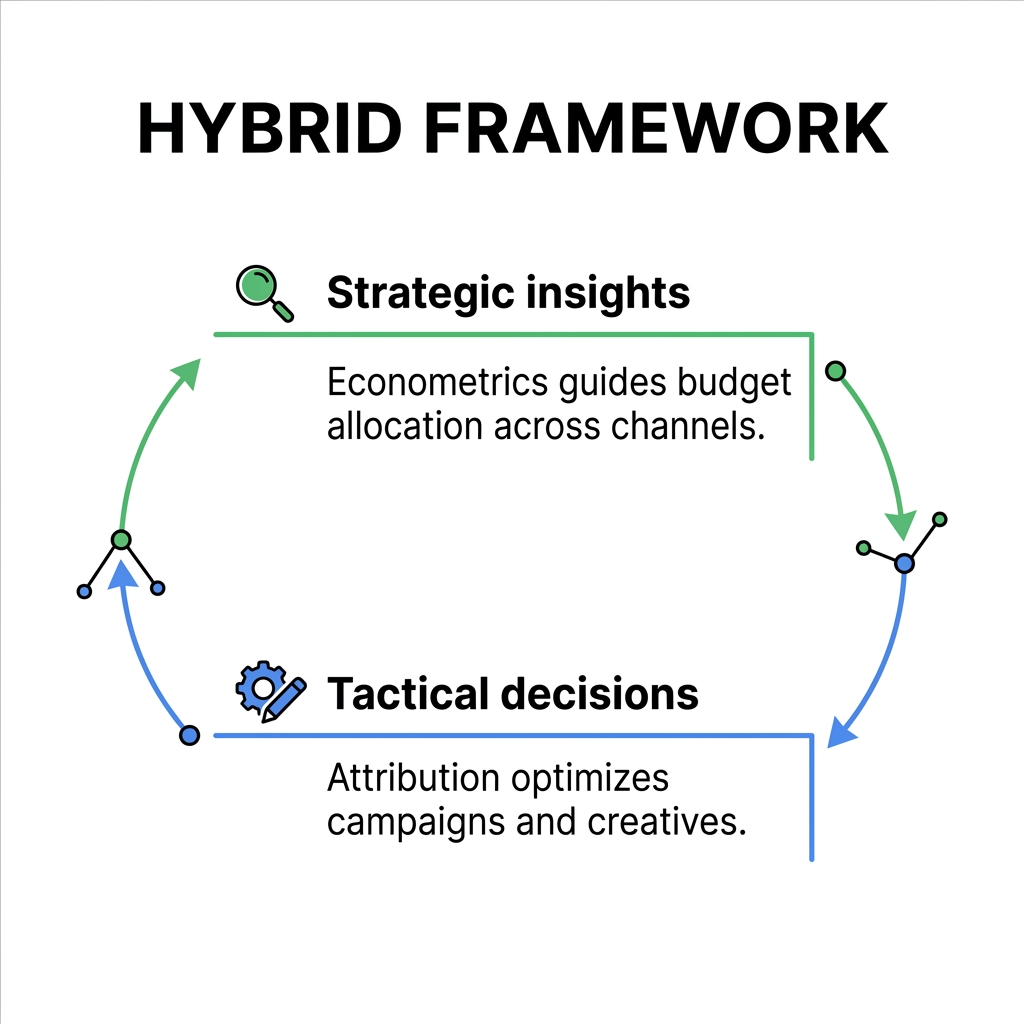
This layered approach allows you to slash ad waste by up to 40 percent by identifying exactly where your next euro will generate the highest marginal return. When you understand the diminishing returns of each channel, you can stop spending on saturated platforms and reallocate that capital to under-exploited opportunities.
Making data-driven budget decisions
Implementing an econometric model requires a solid foundation of data. The data requirements for econometrics typically include at least 18 to 24 months of weekly spend and sales figures. While the initial setup takes more effort than simply installing a tracking pixel, the ROI of marketing mix modeling is substantial. It provides a source of truth that aligns the marketing team with the CFO and CEO.
At Analytical Alley, we use mAI-driven media strategies to help you navigate these complexities. Our models predict the impact of marketing, media, and macro variables with over 90 percent accuracy, giving you the confidence to make bold strategic moves. Whether you are looking for solutions for executives to justify spend or solutions for marketers to optimize performance, we turn complex data into clear directives.
Book a demo to see how our multivariable models can help you identify your true growth drivers and eliminate wasted ad spend.
Get Marketing Analytics Insights
Monthly briefings on marketing mix modeling, budget optimisation and what's actually moving the needle for European brands.